
Prologue
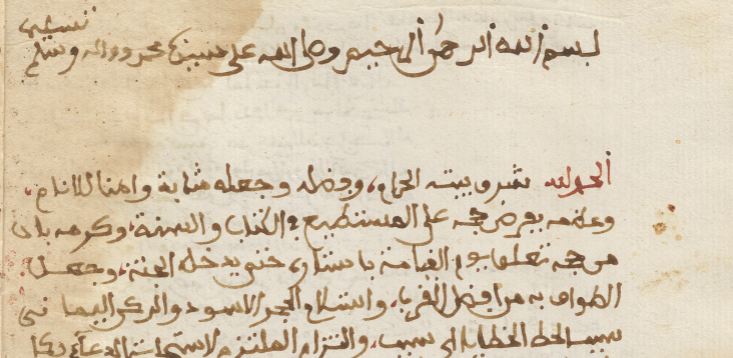
"Praise be to God, who has honored His Sacred House, exalted it, and made it a place of return and a sanctuary for mankind. He magnified it by ordaining the pilgrimage (Hajj) to it for those who are able, as decreed in the Book and the Sunnah. He ennobled it such that whoever undertakes the pilgrimage clings to its coverings until admitted to Paradise. He made circumambulation (Tawaf) around it among the most virtuous acts of drawing near to Him, and made the touching of the Black Stone and the Yemeni Corner a profound means for the remission of sins. He made clinging to the Multazam a guarantor for the answering of prayers for all that is sought, and through the offering of a two-unit prayer (rakʿatayn) behind the Station [of Ibrahim], all past and future sins are forgiven.”
[The exordium (dībaja) of Ikhbār al-Kirām bi-Akhbār al-Balad al-Ḥarām. Qatar National Library Manuscript. Folio 1v]
The pages of this manuscript revolve around the honorable Kaaba; the Ancient House, the heart of the world, the first house established for humanity, and the focal point of yearning souls—a place God ordained as a direction of prayer (Qibla), a sanctuary, and a place of return.
There, where hearts turn before bodies, and where earth embraces heaven, above the Kaaba rises the Dome of Light in the seventh heaven: al-Bayt al-Maʿmūr (The Frequented House). It is circumambulated daily by seventy thousand angels who never return, just as the inhabitants of the earth circumambulate the earthly House.
Mecca, which embraces this profound scene, is not merely a physical location; rather, it is a sacred space where layers of faith, collective memory, and urban architecture intricately intertwine.
Among the rare artifacts that have preserved this ancient Meccan landscape for us is a manuscript copy of the book Ikhbār al-Kirām bi-Akhbār al-Masjid al-Ḥarām (Informing the Noble of the History of the Sacred Mosque) by al-Asadī. This particular Maghrebi copy safeguarded this precious Meccan text until it ultimately found its home within the manuscript collection of the Qatar National Library, under the call number: (HC.MS.2016.0058).
This specific copy stands as a testament to the dynamic circulation of ancient texts and their transmission across the regions of the Islamic world—from Mecca to the Maghreb, and finally to Doha today. It also documents the continued readership and dissemination of this work up until the late 12th century AH / 18th century CE, the period in which it was transcribed.
Thus, this manuscript is born from the very essence and spirit of the place, serving as a historical record of the Kaaba’s architecture and the vistas of the Sanctuary during the author's era. It documents the landmarks and monuments of the House through direct observation and firsthand testimony. By preserving meticulous descriptions and precise details, it offers a vivid, living portrait of those sacred scenes and stations.
About the Author
He is Sheikh Aḥmad bin Muḥammad al-Asadī al-Makkī al-Shāfiʿī, a man of letters and grammarian from Mecca, who also contributed to Shafi'i jurisprudence (Fiqh) and other Islamic sciences. He was born in 1035 AH / 1625–1626 CE and passed away in 1066 AH / 1656 CE.
About the Book and Its Significance
The book Ikhbār al-Kirām bi-Akhbār al-Masjid al-Ḥarām is regarded as a crucial primary source detailing the Meccan Sanctuary and its architectural history during the Ottoman era. Its author masterfully wove together the virtues of the Kaaba, detailed descriptions of the Sacred Mosque, and the prominent landmarks of Mecca. He devoted special attention to the architecture of the Ancient House, encompassing related restoration efforts, the covering of the Kaaba (Kiswa), and the general administration of the Sanctuary.
Among the most vital records preserved in this book—details notably absent from many other historical sources—is the description of the Kaaba's reconstruction ordered by the Ottoman Sultan Murad IV in 1040 AH / 1631 CE. At the time of this event, the author was only about five years old. However, he later met the men who directly oversaw and participated in this construction, hearing from them extensive accounts of the building process and its circumstances. He also personally observed subsequent architectural works and verified related information, enabling him to transmit meticulous details. His account spans from the torrential flood that struck the Kaaba to the specific tasks of engineers, carpenters, and various other artisans and laborers.
The intrinsic value of the book shines through the author's reliance on direct observation, combined with his citations from several significant Meccan sources. Furthermore, he demonstrates a keen critical sense, carefully weighing and evaluating different narratives and scholarly opinions.
Al-Asadī was ultimately unable to complete his work; he passed away at the young age of thirty-one, leaving the book as a draft. His son subsequently took on the responsibility of creating a fair copy (tabyīḍ) and completing the remaining sections. In the book’s introduction, the son wrote: "He died, may God have mercy upon him, before producing a fair copy and appending the things for which he had left blank spaces." Thus, the manuscript has reached us as a witness to two generations: one hand that penned it, and another that brought it to completion.
Selected Excerpts from the Manuscript
The manuscript is replete with valuable insights and fascinating details. We have chosen to present a single excerpt here, inviting the reader to experience an era unlike our own and an architecture of the Noble Sanctuary vastly different from what we know today. The following text reveals an aspect of the architectural and functional life of the Meccan Sanctuary in the past, including structures and facilities, many of which have since disappeared or had their functions altered. The significance of this description is not limited to the visible architecture of the Sanctuary; it extends to the documentation of daily life and associated services—from lamps, oil, and construction tools, to prayer timing instruments, locations for the call to prayer, and the facilities of Zamzam.
Below is the text, followed by an image from the manuscript:
Al-Asadī meticulously describes the landmarks of the Sanctuary, among them the drinking fountain (Siqāyat) of Al-Abbas, near which he notes:
"Behind it is a pleasant, roofed structure designated for the instruments of hospitality (Wifāda), such as the stands used for lowering the lamps, the reeds used to extinguish them, the weekly supply of oil, and the like. Later, another location was built for these instruments near the mosque gate situated beneath the Minaret of Ali, and that [former] location was repurposed for storing some of the mosque’s rubble, such as iron, wood, and construction tools.
Over the Zamzam well, there is a square, roofed structure, surmounted by an awning (ẓulla) containing an elegant dome plated with lead. It was renovated in the year nine hundred and forty-eight [AH] by Emir Khushqaldī.
Within this awning is a fine cabinet containing timekeeping devices (manākīb) to determine prayer times, and beside it is a sundial (mizwala) used to ascertain the elapsed and remaining portions of the day. From here, the chief muezzin calls the prayer, and relays the chants (yuballigh) behind the Shafi'i Imam during prayers.
There is also an elegant, lead-plated dome over the Station of Ibrahim (Maqām Ibrāhīm). [Section on] the description of the Four Stations: It contains four stations for the four Imams..." End of quote.
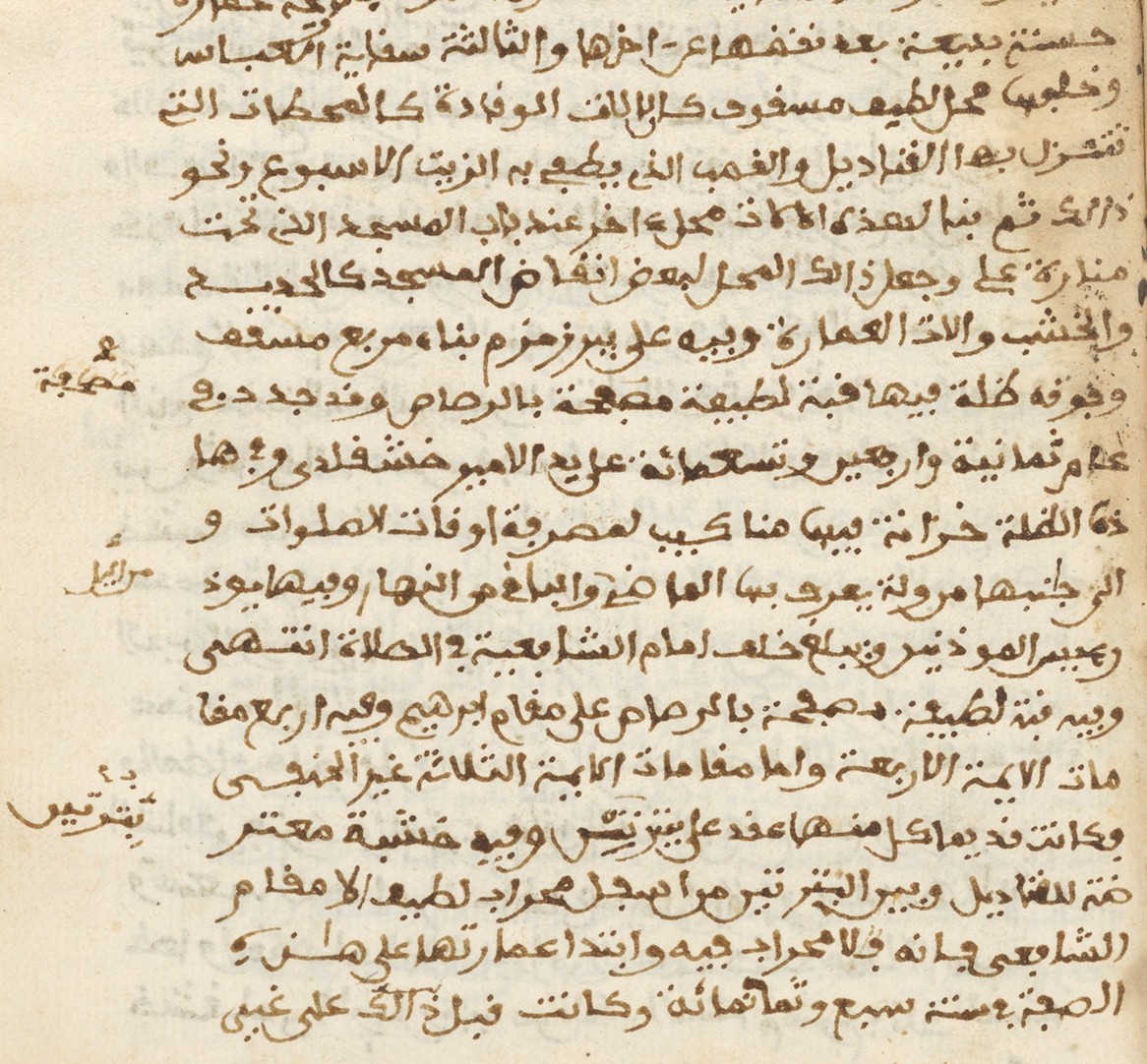
Folio (21r)
We can visualize some features of this architecture through this illuminated miniature from the manuscript Futūḥ al-Ḥaramayn, which helps in conceptualizing several of the architectural elements described by al-Asadī in his text:
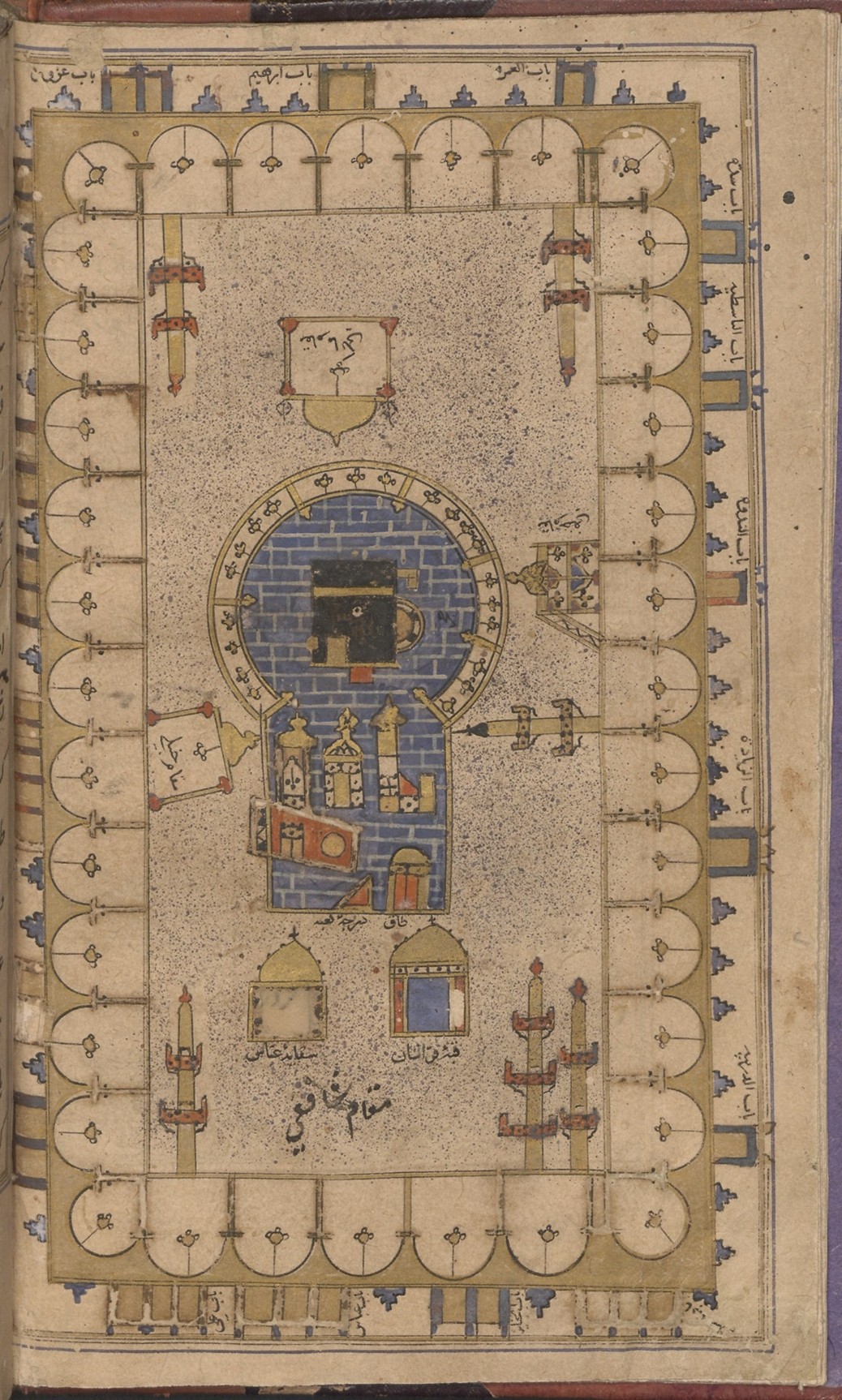
Illuminated miniature of the Sacred Mosque during the Ottoman era
Displaying details of various architectural elements The manuscript Futūḥ al-Ḥaramayn by Muḥyī al-Dīn al-Lārī Indian Subcontinent, estimated 11th century AH / 17th century CE
Qatar National Library. (HC.MS.PER.00338)
[Source: The Holy Kaaba Exhibition. Qatar National Library Website]
Thus, this manuscript does not merely preserve a description of the Meccan Sanctuary; rather, it transmits a living portrait of Mecca's memory and its ancient architecture, as carried by copies through the centuries until it reached us today, ensuring the House remains a focal point of return for the hearts of mankind.
Add new comment