
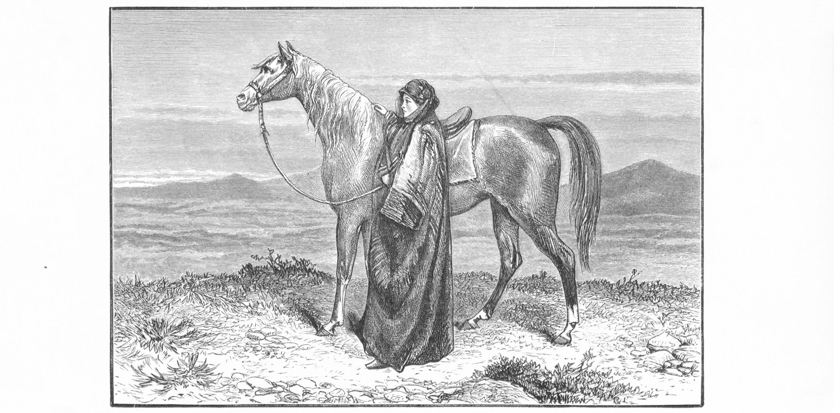
Following Napoleon Bonaparte's military campaign in Egypt in 1798, a substantial body of literature emerged around a previously marginalized topic: women's participation in travel to the East. Through memoirs and personal testimonies, we began to uncover aspects of their hidden contributions to a field long associated with adventure, imagination, and myth. During that era, travel was an adventure across time and space, with a clear demarcation between the traveling "Self" and the distant “Other,” which stirred curiosity and a desire for discovery.
While many of these women’s names have faded from memory, the biographies of some remain alive in memory, evoked by books and reflections. Some undertook the journey alone, driven by a passion for discovery or by religious and ideological motives. Others accompanied their husbands or relatives, as was the case with the British traveler Lady Anne Blunt (1837–1917). Yet, they all defied distances, confronted cultural differences, and transcended prevailing social constraints.

Image 1: A portrait of Lady Anne Blunt in the album of Judith Forbis, breeder of Arabian horses (HC.HP.FOR.0110).
Recent decades have seen a spotlight cast on the prominent contributions of female travelers who explored the world and documented their observations. Today, we have a rich repository of travel literature by both Eastern and Western female writers— a body of knowledge that invites closer reading and discovery of its historical and heritage dimensions. These writings raise numerous questions that continue to engage researchers as they explore this distinctive literary genre.
The Heritage Library holds a significant collection of diverse primary and secondary sources that can enrich the knowledge landscape in this field, opening promising research horizons for those interested in these historical topics and intellectual issues. These works range from published materials to those still in manuscript form.
In this context, our attention turns to the traveler Lady Anne Blunt. She stands out as one of the most prominent voices whose writings distinguished the late nineteenth century, offering rich material that contributes to understanding the image of the East in women's travel literature.
Beginnings and Motives Towards the Unknown
Lady Anne Blunt, who inherited a spirit of adventure and a curiosity for discovery from her grandfather, the Romantic poet Lord Byron, was an Englishwoman of independent character and a clear worldview. Her journey to the heart of the Arabian Peninsula was not merely a passing adventure; rather, it was the culmination of a deep-rooted passion for purebred Arabian horses, coupled with a fascination for the geography of uncharted territories.

Image 2: Cover of the 1881 edition of the book A Pilgrimage to Nejd
In the introduction to her book, A Pilgrimage to Nejd, Blunt notes that the Najd desert represents a firmly established space in the Arab imagination, associated with symbolic figures such as Antarah ibn Shaddad, as a model of chivalry and courage, and Hatim al-Tai, as an icon of Arab generosity. The author employs the symbolic dimension of the desert to justify the title of her book. Regions like the Nafud and Jabal Shammar thus become, in the eyes of these travelers, spaces of symbolic pilgrimage and lands of exploration that they passionately seek to reach.
In 1878, the couple (Anne and her husband, the poet and diplomat Wilfrid Blunt) set out from the Levant toward the heart of the Arabian Peninsula. The motive for this journey was to explore and map the geography of the interior regions and to document the lineages of purebred Arabian horses, which they considered a cultural legacy worthy of study and preservation.
Journey Details and Desert Challenges
During her arduous trek through the heart of the desert, the traveler Blunt paid close attention to documenting the daily details of her journey. She did not settle for mere impressionistic descriptions of what she saw; instead, she meticulously kept a regular diary, recording the smallest details of daily life using tools of a scientific nature.

Image 3: A map showing the route of Anne Blunt's journey to Najd, as it appears in one of the Qatar National Library's copies of her memoirs
Dates and coffee formed the constant daily sustenance for the travelers. In every home, there was a designated coffee area or guest space known as “al-qahwa" where guests were welcomed with a cup of coffee accompanied by dates. This ritual was repeated wherever the team stayed, becoming an integral part of the journey's daily rhythm.
The journey's challenges were not limited to physical exhaustion; they also encompassed harsh environmental conditions, particularly regarding personal hygiene. Blunt faced significant difficulties in maintaining the standards of cleanliness she was accustomed to, given the scarcity of water at most of the stops they made, with the exception of Hail.
Human Interactions in the Heart of Bedouin Culture
Lady Anne Blunt’s interactions with the tribes she met during her journey were characterized by a genuine intellectual curiosity and a deep respect for their culture and traditions. She did not view them as a strange "Other," but sought to understand their way of life from within. She shared their simple food, sat on their modest rugs, and engaged in evening gatherings that touched upon pivotal issues such as the custom of blood vengeance or the concept of tribal retaliation and tales of ancient battles that helped shape their collective memory.
Blunt was keenly aware of the deep cultural divide separating her world from the Bedouin world—an awareness reflected in her precise observations. She noted the absence of the overt religious manifestations she was accustomed to seeing in cities; there were no bustling mosques or visible worship rituals, except for what she recorded among the Bani Nasir, where the impact of the Wahhabi movement was still present.

Image 4: Page 238
At night, stories abounded to fill the void of the desert silence, and singing grew louder. Her musical background refined her ear, enabling her to capture rhythms and transcribe melodies with the skill of an expert well-versed in the foundations of the musical scale. Likewise, her mastery of drawing allowed her to visually document the scenes she experienced.
Other cultural aspects also caught her attention, including the strong belief in destiny within the Bedouin worldview. Everything that happened in life, whether good or bad, was attributed to the will of God. She was also struck by the profound symbolic weight of the "word" in this society, as statements were taken seriously even in the absence of tangible material proof. In the course of these encounters, Blunt had the rare opportunity to enter the women’s quarters of Emir Muhammad bin Rashid’s household in Hail, gaining a close view of aspects of social life there.
Exploring the Natural Environment and its Wonders
Blunt's focus during her journey was not limited to human and cultural aspects; it also encompassed the natural environment in all its manifestations. She carefully recorded her observations of the desert sky, weather fluctuations, and the types of birds and plants she encountered, in a clear endeavor to understand the natural phenomena surrounding her. She also showed a particular fascination with the diversity of the desert terrain and an admiration for the Bedouins' remarkable ability to navigate these vast spaces, contrasting this with her own reliance on modern navigation tools.

Image 5: Page 170
The deep historical dimension of this land did not escape her notice. She documented the ancient inscriptions discovered in certain areas, alongside the narratives and interpretations provided by local inhabitants regarding those antiquities.
Encounters in Hail: Politics and Hospitality
Upon the team's arrival in Hail, they received a grand reception from Emir Muhammad bin Rashid. This took the form of a large banquet that included not only the European guests but also their escorts and a number of the city's residents, embodying the essence of Bedouin hospitality.

Image 6: Page 305
That evening, Blunt analyzed the character of Emir Muhammad bin Rashid, describing him as having a strong presence accompanied by a clear tendency for ostentation. Conversely, she noted the quiet and cautious role played by his advisor, Hamoud. These observations afforded her a deeper understanding of the power structure in Najd and the balance of political power at the time.
The Explorer's Perspective and Her Relationship with Predecessors (Palgrave as an Example)
William Gifford Palgrave was a British Orientalist and diplomat who preceded Lady Anne Blunt in exploring the Arabian Peninsula, publishing his famous journey in 1865. Lady Anne was familiar with Palgrave's work and sometimes relied on it as a geographical and historical source. However, she did not hesitate to implicitly criticize some of his premises, particularly his obvious inclination to favor urban spaces over Bedouin life.

Image 7: Map HC.MAP.00170
Blunt felt that some of Palgrave's observations lacked accuracy and careful scrutiny. As a result, her journey and her book act as an indirect correction to some of the previous misconceptions about the region.
The Writer as a Woman in a Male-Dominated World
Blunt’s style shows considerable restraint in addressing her position as a European woman moving through a traditional, male-dominated Bedouin space. Throughout most of her narrative, she does not make her gender the central focus of her discourse; instead, she seeks to blend into the overall scene, transcending gender differences in the language of her account.

Image 8: Page 12
On the other hand, there are distinct moments where her personal voice clearly emerges, such as her scream during a sudden attack—a voice stemming from an instinctive human fear rather than personal weakness. In her interactions with local women, Lady Anne displayed a marked sensitivity to women’s experiences, recording precise observations about their private world.
The Journey's Legacy and Continued Reflection
Concluding this narrative of Blunt's journey, her independent personality, deep passion for knowledge, precise observation, and cultural sensitivity clearly emerge—traits that are reflected in the entirety of her journey's details and writings. Her journey to Najd was not merely a passing act of exploration or geographical curiosity; rather, it constituted a complex and profoundly impactful human experience that unveiled intertwining worlds of nature, culture, and patterns of human relations.
Through her book, Lady Anne Blunt left behind a highly significant intellectual legacy, embodied in a rich repository of precise observations and critical reflections that helped document fundamental aspects of the history and culture of the Arabian Peninsula during that era. This legacy also presents a vivid portrait of a pioneering woman who transcended the boundaries of her time and space, penetrating relatively closed geographical and cultural spheres, driven by a love of knowledge and a passion for exploration.
Add new comment